 Hollowpine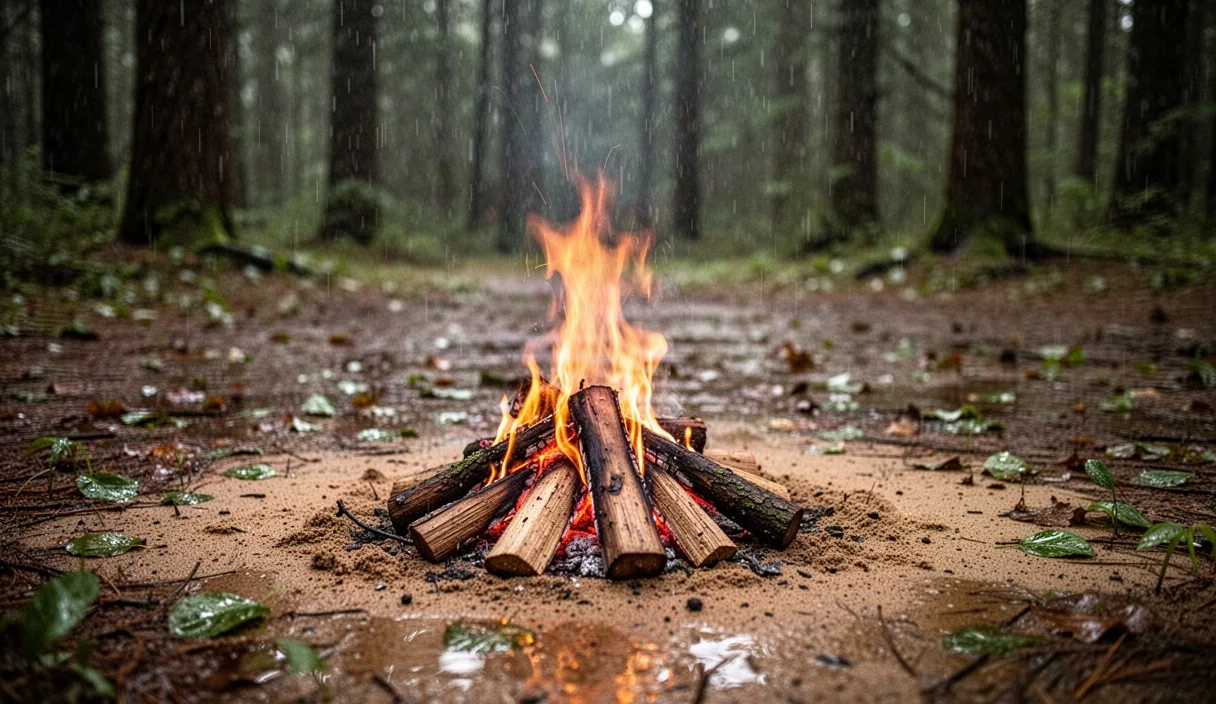
Rain does not just dampen wood, it dampens judgment. Most people who fail to get a fire going in wet weather do not fail because the conditions were impossible, they fail because they tried to build a normal fire and hoped it would work anyway. Wet-weather fire craft is a different skill set, built on reading moisture, choosing wood by its position rather than its size, and controlling airflow before you control flame.
This guide walks through the process in the order it actually happens in the field: assessing why the obvious approach fails, finding tinder that has never touched standing water, harvesting wood that is dry on the inside even when the outside is soaked, building a base that keeps the fire off wet ground, shielding the first flames from active rain, and feeding the fire correctly once it catches. It closes with backup options worth carrying so a failed attempt never becomes the only attempt.
Why Most Wet-Weather Fires Fail Before They Start
The common mistake is treating rain as the main obstacle when ground moisture and airflow usually cause more failures. A fire built directly on saturated soil or wet leaf litter loses heat downward faster than a small flame can produce it. The fire is not fighting the rain overhead, it is fighting the cold, wet mass underneath it.
The second failure point is fuel selection under pressure. When someone is cold and wet, the instinct is to grab whatever wood is on the ground and pile it on. Ground-level wood in wet weather has usually been absorbing moisture for hours or days, even if the outer bark looks fine. A stick that feels dry to the touch can still be carrying enough internal moisture to choke a young flame with steam instead of feeding it.
Third, people underestimate how much oxygen a fire needs in damp conditions. Wet wood burns less efficiently, which means it needs more airflow, not less, to reach a self-sustaining temperature. Structures that are too tight, or tinder piled too densely, smother the exact fire they are meant to protect.
The three conditions a wet-weather fire needs
- Fuel that is dry on the inside, regardless of what the weather has done to the outside
- A base that separates the fire from wet ground or snow
- Enough airflow to let a small flame build heat faster than moisture can absorb it
Finding Dry Tinder When Everything Looks Soaked
Dry tinder in wet weather is almost never sitting on the ground. It is found where rain cannot reach directly: under the outer bark of standing dead trees, inside the hollow centers of dead branches still attached to a tree, or on the underside of dense evergreen canopies where the lowest branches have kept several square feet of ground and needles dry even during hours of rain.
Birch bark is one of the most reliable wet-weather tinders because its natural oils repel water and it burns even when slightly damp. Peel thin curls from a standing birch, not from wood lying in leaf litter. Fatwood, the resin-saturated heartwood found at the base of dead pine branches or in old pine stumps, is another strong option: it lights even when wet on the surface because the resin itself is the fuel, not the wood fibers.
Standing dead grass, cattail down, and the fine inner bark fibers of cedar can also work if they are gathered from above ground level, not from anything lying flat where rain pools. A pocketknife is the right tool here: shave curls from the driest interior of a stick rather than relying on whatever is exposed on the surface.
- Birch bark, peeled from standing trees, not fallen ones
- Fatwood or pine resin knots from dead branch stubs
- Inner bark fibers scraped from dead, standing cedar or juniper
- Dry pine needles or grass pulled from under a dense evergreen canopy
Carry a small amount of processed tinder before conditions turn wet. Cotton balls worked with petroleum jelly, dryer lint, or commercial tinder cubes stored in a sealed container remove the search entirely and should be treated as the first option, not the last resort.
Selecting and Preparing Dry Wood From Standing Sources
The rule that changes everything in wet weather: standing dead wood is almost always drier than fallen wood, because it has spent less time absorbing ground moisture and more time exposed to wind. A dead branch still attached to a tree, especially one that snaps cleanly rather than bending, is a strong candidate. Bend-testing is the fastest field check: wood that snaps with a sharp crack is dry enough to burn, wood that bends or feels rubbery is holding too much moisture.
Once you have standing dead wood, the outer layer, roughly the first quarter inch, is usually the wettest part after rain. Batoning, splitting a piece of wood lengthwise with a knife and a stick used as a baton, exposes the dry interior. This works on branches from finger-thickness up to wrist-thickness and is one of the most reliable techniques in sustained rain, because the split faces can go straight into the fire while the wet exterior is discarded or used later once the fire is established.
Softwoods like pine, spruce, and fir are generally better choices in wet conditions than hardwoods because their resin content helps them ignite even with some residual moisture. Hardwoods like oak or maple burn hotter and longer once a fire is established, so the practical approach is softwood to start, hardwood to sustain.
| Wood type | Wet-weather ignition | Best use |
|---|---|---|
| Pine, spruce, fir | Good, resin ignites despite moisture | Starting the fire |
| Birch | Good, bark repels water | Tinder and kindling |
| Oak, maple, ash | Poor when wet, needs a hot base first | Sustaining heat once established |
| Cedar | Good, splits easily, low moisture retention | Kindling and inner bark tinder |
Building a Raised Base to Beat Ground Moisture
A fire built on wet ground loses a measurable amount of its early heat straight down into the soil, which is why raising the fire off the ground matters as much as fuel selection. A simple platform made from several green logs, roughly wrist-thick, laid side by side, creates an insulating layer between the fire and wet earth. Green wood does not burn easily, which is exactly why it works as a base rather than fuel.
In snow or standing water, the platform needs to be thicker, sometimes two layers of logs laid in a crosshatch pattern, because a single layer can sink or get soaked through within the first twenty minutes. Flat stones can substitute for logs where available, though wet stones taken directly from a stream should be avoided since trapped moisture in stone can cause them to crack or, in rare cases, fracture sharply when heated.
On sloped or uneven ground, a small trench dug a few inches deep and lined with dry bark or bundled sticks achieves a similar separation from surface water runoff. The goal is not elevation for its own sake, it is creating a dry, insulated layer between the flame and whatever moisture is sitting in the ground beneath it.
Structures That Shield a Young Flame From Rain
A young flame needs shelter from direct rain without losing the airflow it depends on. The teepee structure, tinder and small kindling arranged in a cone with an opening on the windward side, works well because its shape naturally sheds water while funneling air upward through the center. It is the most common choice for a reason: it self-corrects as it burns, collapsing inward rather than falling apart.
The log cabin structure, kindling stacked in alternating square layers around the tinder, offers more physical protection from direct rain since the upper layers act as a partial roof, but it needs more careful spacing between pieces or it starves the flame of oxygen. This structure works best when rain is steady but light, rather than heavy and wind-driven.
In sustained heavy rain, an overhead shelter separate from the fire structure itself, a lean-to of bark or a tarp pitched at an angle several feet above the fire, matters more than the wood structure underneath. The tarp should never be low enough to trap heat and smoke against it, both because of fire risk and because most synthetic tarp materials are not rated to handle direct flame contact.
- Teepee structure: best all-around choice, self-clearing, good in wind
- Log cabin structure: better rain shielding, needs wider air gaps
- Overhead tarp or bark lean-to: essential in sustained heavy rain, keep it several feet above the flame
Feeding the Fire Without Smothering It
Once a flame catches, the instinct to add more wood immediately is usually premature. A fire needs roughly a few minutes of building heat on its initial fuel load before it can handle anything thicker than pencil-width kindling. Adding a fist-sized piece of wood too early, especially a wet one, can drop the internal temperature below what is needed to keep burning and the fire dies quietly under its own fuel.
The correct feeding order is small to large in deliberate stages: pencil-width kindling first, then finger-width, then wrist-width, each addition given a minute or two to catch before the next size goes on. In wet conditions, pre-splitting several sizes of wood before starting the fire saves critical time, because searching for the next size up while the flame is still small often costs the fire its momentum.
Blowing gently at the base of the flame, or fanning with a hat or piece of bark, supplies the extra oxygen that wet fuel needs to combust fully instead of smoldering. Steam and heavy white smoke rising from added wood is a normal sign that moisture is being driven off, not a sign of failure, provided flames are still visible underneath. If flames disappear entirely and only smoke remains, remove the last piece added and let the existing coals rebuild heat before trying again.
What to Carry as a Backup Fire Starter
Relying entirely on field-found materials in wet weather is a reasonable skill to practice but a poor plan to depend on when conditions are already working against you. A small waterproof container with two or three redundant options removes most of the risk.
- Waterproof matches or a butane lighter stored in a sealed bag, since standard lighters can fail after prolonged dampness
- A ferrocerium rod, which throws sparks even when wet and works well paired with fatwood shavings
- Commercial tinder, either wax-based cubes or petroleum-jelly cotton balls, sealed separately from anything that might get crushed or contaminated by fuel odor
- A small amount of dry fuel, such as a folded strip of birch bark or a wax-paper fire starter, kept specifically untouched until every other option has been tried
Test any backup fire starter before relying on it in the field, since some ferrocerium rods and lighters vary significantly in reliability between brands. If a fire cannot be established after a reasonable, sustained effort in genuinely dangerous cold or wet conditions, treat that as a signal to prioritize shelter and body heat retention over continued fire attempts, and seek other means of warmth or evacuation rather than risking hypothermia while troubleshooting.
Common Mistakes
- Gathering tinder and kindling from the ground instead of from standing dead wood or sheltered canopy areas
- Skipping the raised base and building directly on wet soil, losing heat downward from the first minute
- Building an airtight structure that looks protected but starves the flame of oxygen
- Adding thick or wet fuel too early, before the fire has built enough heat to process it
- Carrying only one fire-starting method and assuming it will work regardless of conditions
Next Steps
Practice this sequence in dry weather first so the motions of batoning wood, building a raised base, and feeding a fire in stages become automatic before conditions make them harder. Then deliberately practice once in light rain, with backup starters on hand, to see firsthand how much longer each stage takes and where your own gear or technique falls short. Building that experience under manageable conditions is what makes the process reliable when the weather is not.